

-
Hopkins Bloomberg Center
Washington, DC
- Ph.D. in Economics, Stanford University
- J.D., Stanford Law School
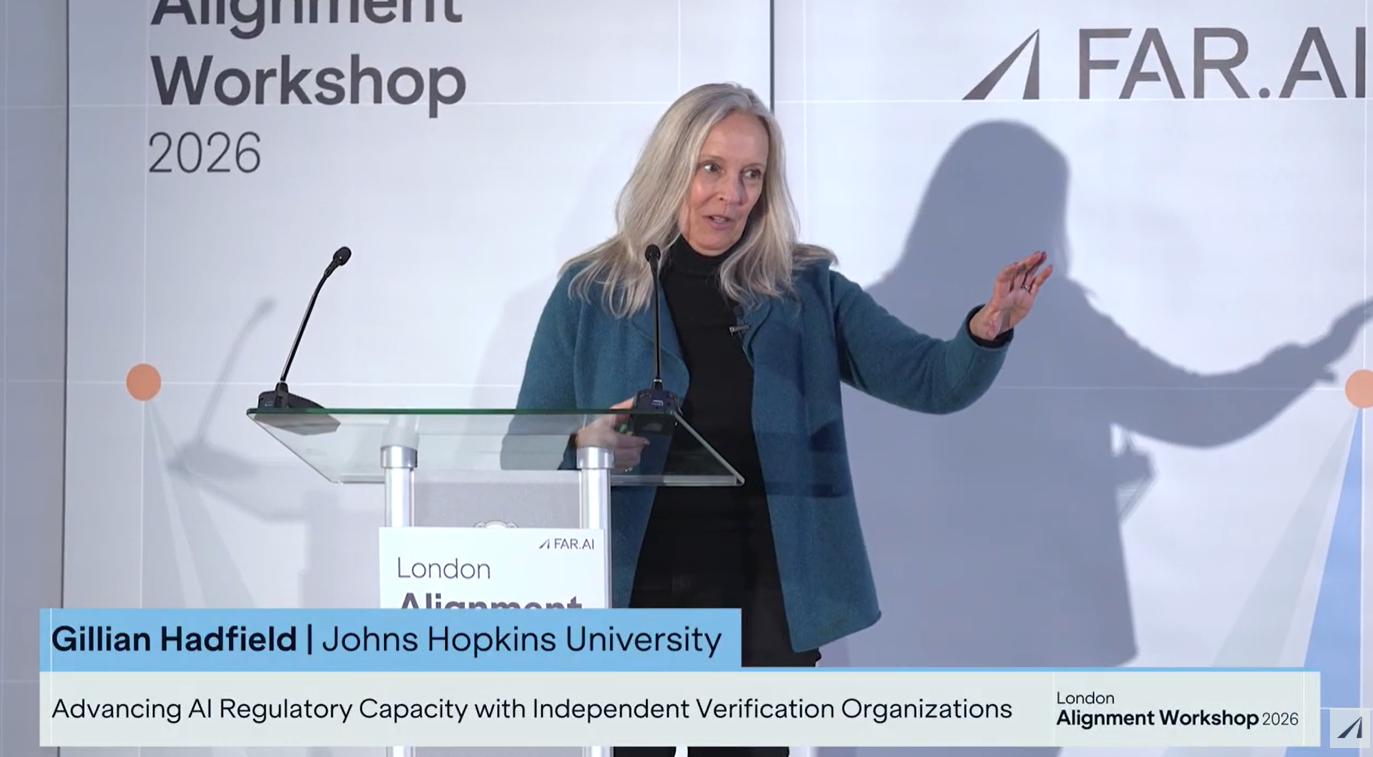
Gillian K. Hadfield’s research focuses on innovative design for legal, regulatory, and technical systems for AI, computational models of human normative systems, and building AI systems and agents that understand and respond to human values and norms.
Hadfield is currently working on the challenge of AI governance and alignment problems and computational models to analyze the phenomenon and characteristics of normativity and legal order. For AI to be beneficial to society, it will have to integrate into our normative systems; at a minimum, it must not break these complex, dynamic processes—the systems that underpin our willingness to engage in the phenomenal levels of interdependence and cooperation that characterize modern human societies. This involves determining how to build AI systems that advance human normative efforts, enabling us to find and live by better rules; achieve fairer, more just, and more peaceful societies; and support human flourishing. Her approach is grounded in a career focused on understanding human norms and institutions that promote human well-being.
Hadfield is Bloomberg Distinguished Professor of AI Alignment and Governance, cross-appointed in the Department of Computer Science where she leads the Normativity Lab. She is also a Visiting Faculty Researcher with Google’s Paradigms of Intelligence team where she collaborates on technical research informed by her work on building normatively competent agents for multi-agent cooperation, a Faculty Member at the Vector Institute for AI, and a Senior Advisor to Fathom, an independent AI policy nonprofit organization. She is a Schmidt Sciences AI2050 Senior Fellow and serves as Chair of the Board of Trustees of the Cooperative AI Foundation. She served as a Senior Policy Advisor at OpenAI from 2019 to 2023. She was President of the Society for Institutional and Organizational Economics and the Canadian Law and Economics Association and has served on the Boards of Directors of the American Law and Economics Association and the (former) International Society for New Institutional Economics.
Hadfield previously served as inaugural director of the Schwartz Reisman Institute for Technology and Society at the University of Toronto, where she was cross-appointed on the Faculty of Law and the Rotman School of Management, and held the Schwartz Reisman Chair in Technology and Society. Among Hadfield’s awards and honors are the 2024 Carolyn Tuohy Impact on Public Policy Award and President’s Impact Award from the University of Toronto; the 2019 Mundell Medal for Excellence in Legal Writing for her book, Rules for a Flat World: Why Humans Invented Law and How to Reinvent It for a Complex Global Economy; and a 2018 Phi Kappa Phi Faculty Recognition Award. She was awarded a Rockefeller Foundation Bellagio Center Residency in 2022, and was a fellow of the Center for Advanced Study in the Behavioral Sciences at Stanford from 2006 to 2007 and again from 2010 to 2011. Hadfield has published in leading journals, including Science, Science Advances, Nature, Proceedings of the National Academy of Sciences of the United States of America, and the Annual Review of Political Science, as well as in the Proceedings of the AAAI/ACM Conference on AI Ethics and Society.
Prior to joining Hopkins in 2024, Hadfield held faculty positions at the University of California Berkeley, the University of Southern California, and the University of Toronto. She has been a visiting professor at Harvard, Chicago, Columbia, and NYU. She earned her bachelor’s degree from Queen’s University, her J.D. from Stanford Law School, and completed her Ph.D. in economics at Stanford University.