
The rise of the abundance faction
By working within a party, the new supply-siders can boost their cause — and pull us away from left-right polarization.
In Short:
By working within a party, the new supply-siders can boost their cause — and pull us away from left-right polarization.
Abstract
For nearly a decade now, political moderates have been on their heels, as right-wing populists have taken the reins of the Republican Party and democratic socialists have established a beachhead in the Democratic Party. In response, startled and flailing moderates, including the authors, have grasped for institutional footholds within the two parties. Some have latched on to the idea of creating a moderate faction inside the Democratic Party with its own distinctive ideology, institutions, and sources of funding and organization. Others have given up on the two major parties and flirted with the idea of a moderate third party.
We have, with some reluctance, concluded that moderation itself is a dead end. For one thing, the explicit pursuit of moderation can easily fall into the trap of simply splitting the difference between two moving goalposts rather than advancing a distinct, morally grounded policy agenda. Additionally, and just as a pragmatic matter of political organizing, it is hard to rally a group of intensely motivated and dedicated activists behind the milquetoast banner of moderation; it typically doesn’t inspire the kind of passion that fuels political movements.
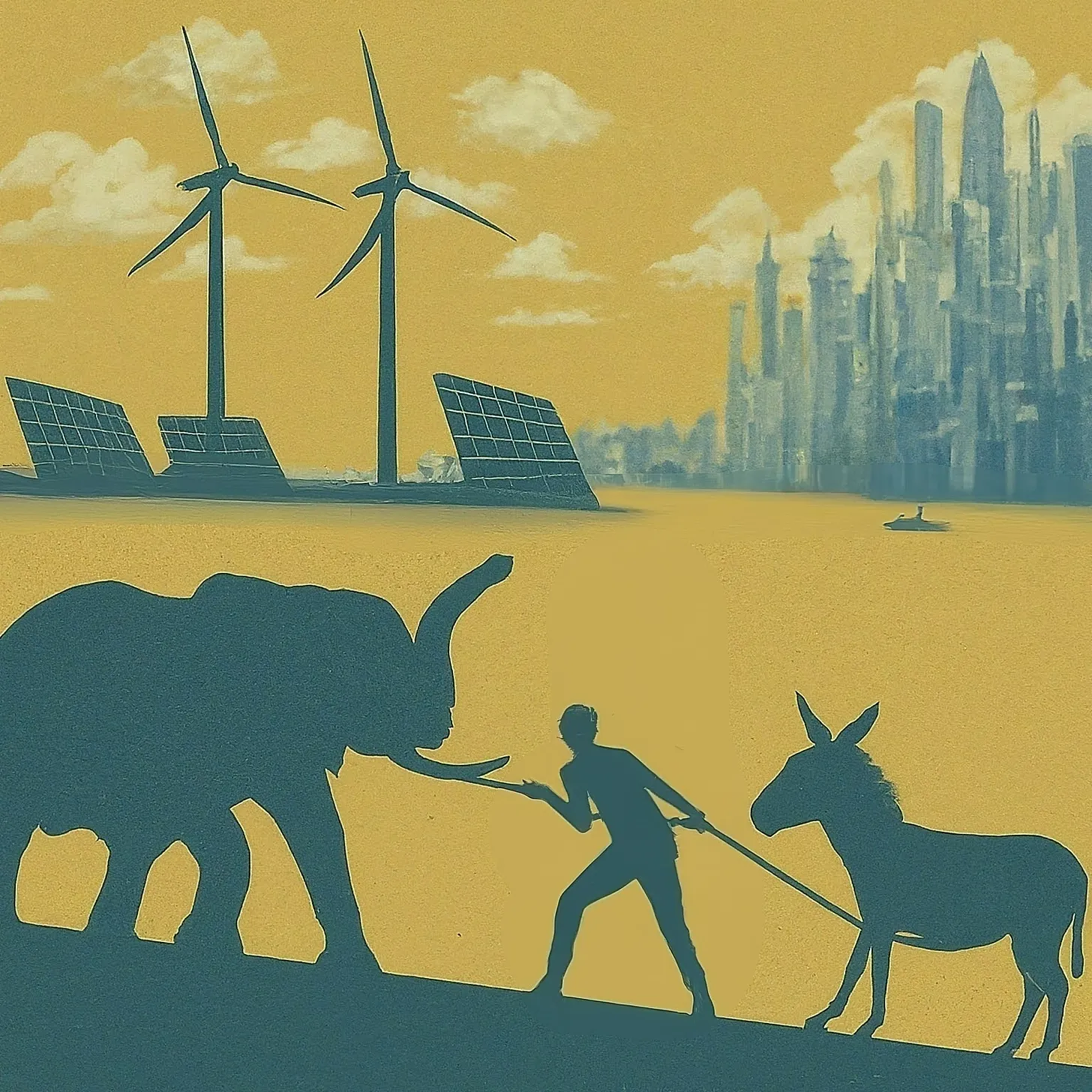
Rather than trying to address the challenge of polarization by finding some space between the intellectually exhausted agendas of the right and left, we should focus instead on injecting an alternative dimension into our political discussion — the “Abundance Agenda” that we see as the answer to “Cost Disease Socialism.” Instead of positioning ourselves by watering down populist conservatism or progressivism, Abundance has its own quite sweeping package of reform that envisions a wholesale program of state-building–building housing, clean energy, and infrastructure by reforming our creaky, captured systems of governance at all levels, and building a simpler, more effective and democratically legitimate welfare and regulatory state. Like the Progressives of the late 19th and early 20th century, the supporters of abundance seek to simultaneously dismantle an exhausted, maladapted, and frequently corrupt state structure with one built for the problems of today.
Rather than trying to fix polarization by finding space between the intellectually exhausted agendas of the right and left, we should inject an alternative dimension into our politics.
Because the American political system is heavily biased against third parties, the best path for pursuing this agenda lies with the kind of intra-party factions that have been common throughout U.S. history (of which the Progressives were one). In the long term, we can hope that many of the politically homeless elements that used to be firmly ensconced in the Republican Party will reemerge as a political force around their own version of Abundance rather than under the exhausted banner of Reagan-era fusionism. In fact, members of Congress like Sen. Todd Young of Indiana have already been leaders on many abundance-related issues. However, given Donald Trump’s hold on the GOP, in the short term, it is hard to imagine such a political faction emerging around these issues anywhere other than the Democratic Party.
For now, then, the factional action on Abundance will be among the Democrats. The table is set for just such a faction to emerge. But it won’t appear out of thin air. It will require deliberate action in the form of organizing, mobilizing, and engaging at both the elite and mass levels. Advocates of Abundance will need to pursue their agenda with the same kind of concerted effort that the MAGA movement and the democratic socialists have been willing to undertake. To borrow a slogan from the left, Abundance advocates will need to educate, agitate, organize.
The potential payoff of organizing Abundance advocates into a coherent party faction is enormous. For Democrats, it would expand the party’s reach and allow it to win and maintain governing majorities. For supporters of an Abundance Agenda, it would address the new set of issues that, left unaddressed, will continue to be a drag on our economy and on our fellow citizens’ pursuit of happiness. And for the country, it would enable a more dynamic, pluralistic, and representative future for American democracy.
About the author

Steven Teles
professor, school of government and policy
Steven Teles is a political scientist focused on the intersection of political economy, public policy, political parties and ideology.