
Democracy Reform Primer Series

About the series
Narrowing the gap between research and public dialogue, the primers responsibly advance conversations and strategy about proposed changes to our political institutions. Launched in 2024 by the University of Chicago’s Center for Effective Government (CEG), the series is now led in partnership between CEG and Johns Hopkins University’s School of Government and Policy.
Each primer focuses on a particular reform idea, clarifies its intended purposes, and critically evaluates what the best available research has to say about it.
The primers do not serve as a platform for either authors or the institutional partners to advance their own independent views about the reform. To the contrary, they serve as an objective and authoritative guide about what we actually know—and what we still don’t know—about the likely effects of adopting prominent reforms to our political institutions.
The available evidence may clearly support or cut against the claims of a reform’s advocates, and be mixed, indeterminate, or altogether silent.
Without partisan judgment or ideological pretense, and grounded in objective scholarship, these primers set the record straight by clarifying what can be said about democracy reforms with confidence and what requires further study.
About the editor

Anthony Fowler
Anthony Fowler is the founding editor of the Democracy Reform Primer Series, a professor at the Harris School of Public Policy, and the director of the Center for Effective Government at the University of Chicago. His research applies econometric methods for causal inference to questions in political science, with particular emphasis on elections and political representation. Fowler is currently the co-editor in Chief of the Quarterly Journal of Political Science, and the co-author (with Ethan Bueno de Mesquita) of Thinking Clearly with Data: A Guide to Quantitative Reasoning and Analysis (Princeton University Press, 2021). Fowler earned his Ph.D. in government from Harvard University and completed undergraduate studies at the Massachusetts Institute of Technology.
About the director

Brooke Brower
Brooke Brower is the director of the Democracy Reform Primer Series at Johns Hopkins University’s School of Government and Policy. For more than two decades, he worked at the center of American political journalism — producing and leading coverage at ABC News, CNN, and MSNBC that shaped how millions understood elections, policy, and democratic institutions. Before joining Johns Hopkins, he was executive producer of ABC’s This Week with George Stephanopoulos, earning four Emmy nominations, and previously served as the managing editor of CNN’s digital political coverage. Earlier in his career at MSNBC, he launched programs and produced presidential primary debates. He has taught courses at Georgetown and Northwestern, where he earned a master’s degree, and holds a B.A. from the University of Virginia.
Explore the series
-

Condorcet Voting
In several respects, Condorcet voting does a better job of reflecting voters’ preferences in political elections than do the most common voting methods in current practice.
Learn More -
Direct Democracy and Ballot Measures
Allowing citizens to vote on important public issues at the national level, and expanding the use of direct democracy at the state and local levels would allow citizens to bring government policies toward the center, counteracting the extremism in the two major political parties; and by making government more responsive to the people, could help restore trust in the government and relieve populist pressures.
Learn More -

Top-Two Primary Elections
In recent years, the top-two system has gained popularity among reformers to reduce polarization.
Learn More -

Filling Bureaucratic Vacancies
It is taking far longer for presidents to nominate, and the Senate to confirm, federal agency leaders than in the late twentieth century. These growing gaps in leadership have led to a corresponding increase in the use of acting officials and delegations of authority, where statutes permit such substitutes. These stand-ins for confirmed leaders generally hurt agency performance and accountability, but sometimes contribute needed expertise and yield a better nominee. Good governance advocates push to reduce the number of Senate-confirmed agency slots and to impose more restrictions on acting officials in the highest positions that remain. These reforms likely would improve governance and agency accountability but could have unexpected consequences.
Learn More -
Proportional Representation for the U.S. House
A prominent electoral reform movement (1) in the United States favors Proportional Representation (PR): the creation of multi-member districts in which seats are allocated to parties in proportion to their vote. Advocates argue that this reform would lead to policies with broader support, improve the accountability of elected officials, and enhance political stability.
Learn More -

District vs. At-Large Elections
At-large elections are discriminatory (1). Adopting district elections will improve descriptive representation for marginalized groups, produce councilors who are closer to voters, and generate political outcomes that are more likely to address the needs of neighborhoods.
Learn More -
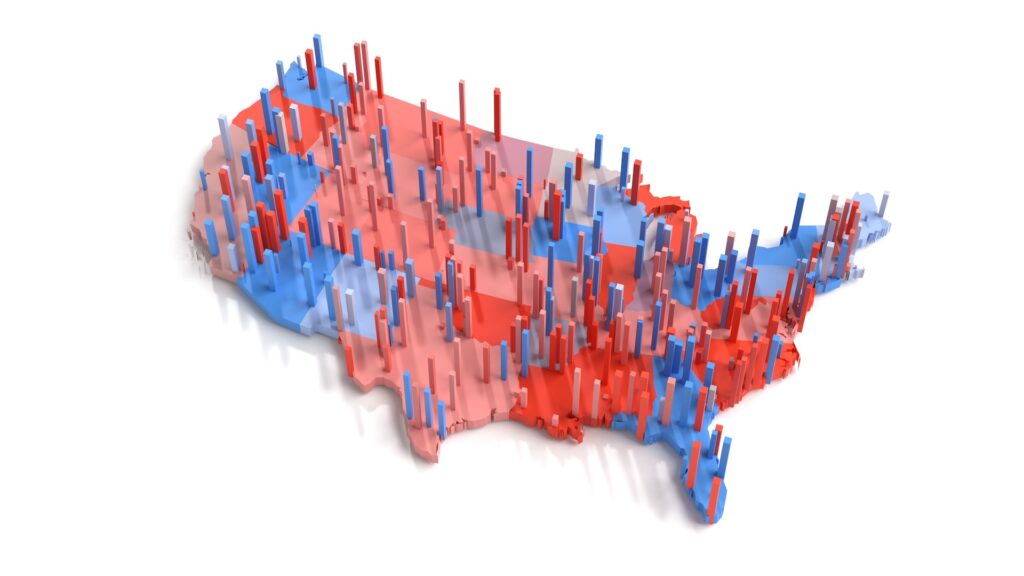
Ending the Electoral College
The Electoral College directs candidate efforts and attention to a small set of states. This tendency has increased dramatically over time because of increased political polarization and improved polling. It has reduced political participation in neglected states and biased some policies over which the president has more control. The simpler National Popular Vote system would eliminate these negative consequences and equalize the importance of voters across America.
Learn More -
Nonpartisan Election Officials
Partisan election officials may administer elections in ways that advantage their party. Replacing partisan officials with appointed nonpartisan bureaucrats would make election administration fairer and increase the legitimacy of election outcomes.
Learn More -

Implementing Schedule F
Critics contend that the federal bureaucracy is bloated, career civil servants are not responsive to the president’s demands, and it is difficult to fire poor performers. Schedule F would convert many mid- to high-level career civil servants to at-will employees. The intended goal of this reform is to increase political responsiveness and improve agency performance.
Learn More